Charleston Defenses · Book p. 103
Battery at Vanderhorst's Wharf
An earthwork on the Cooper River waterfront, inside easy range of the Federal guns on Morris Island.
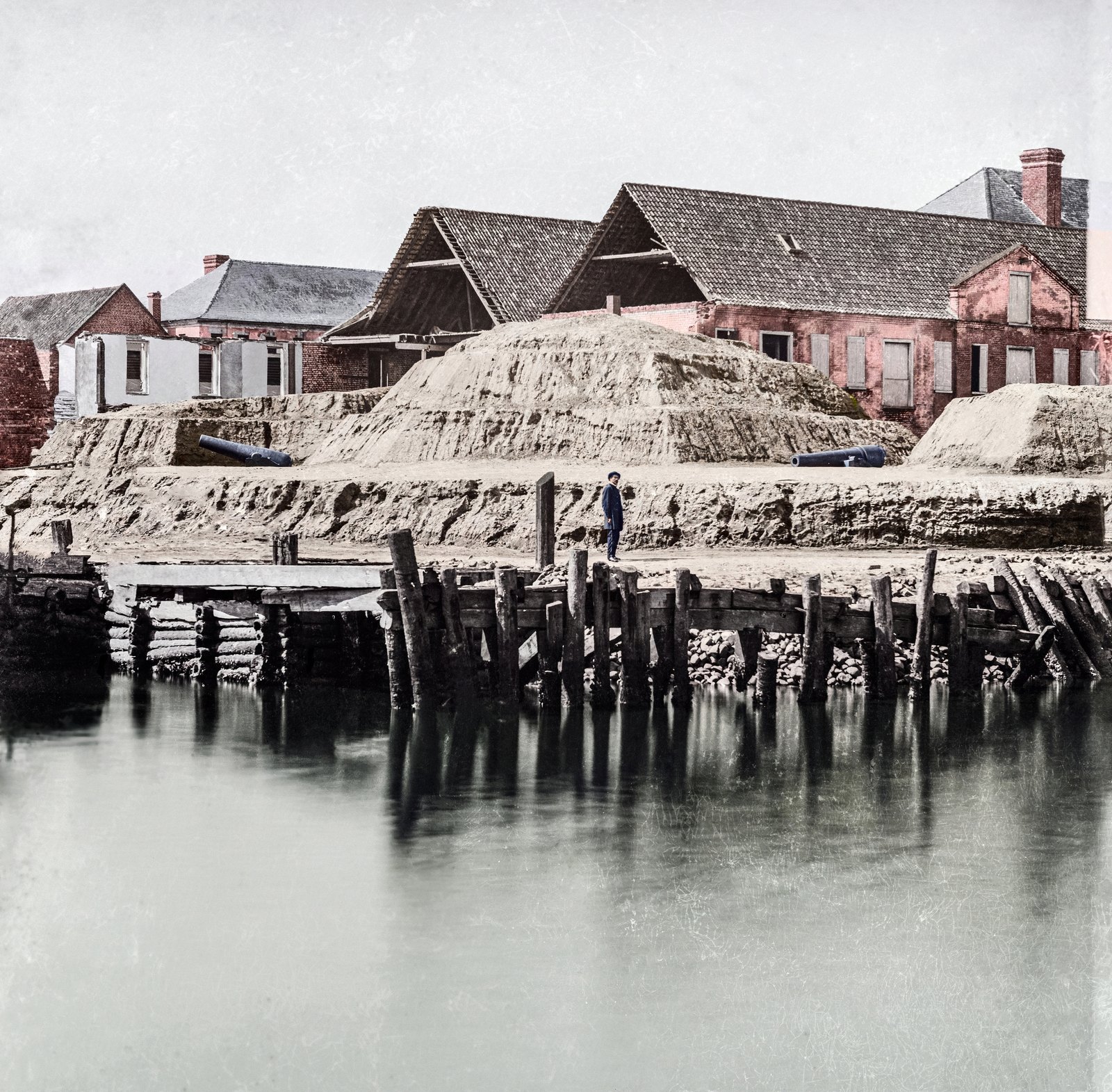
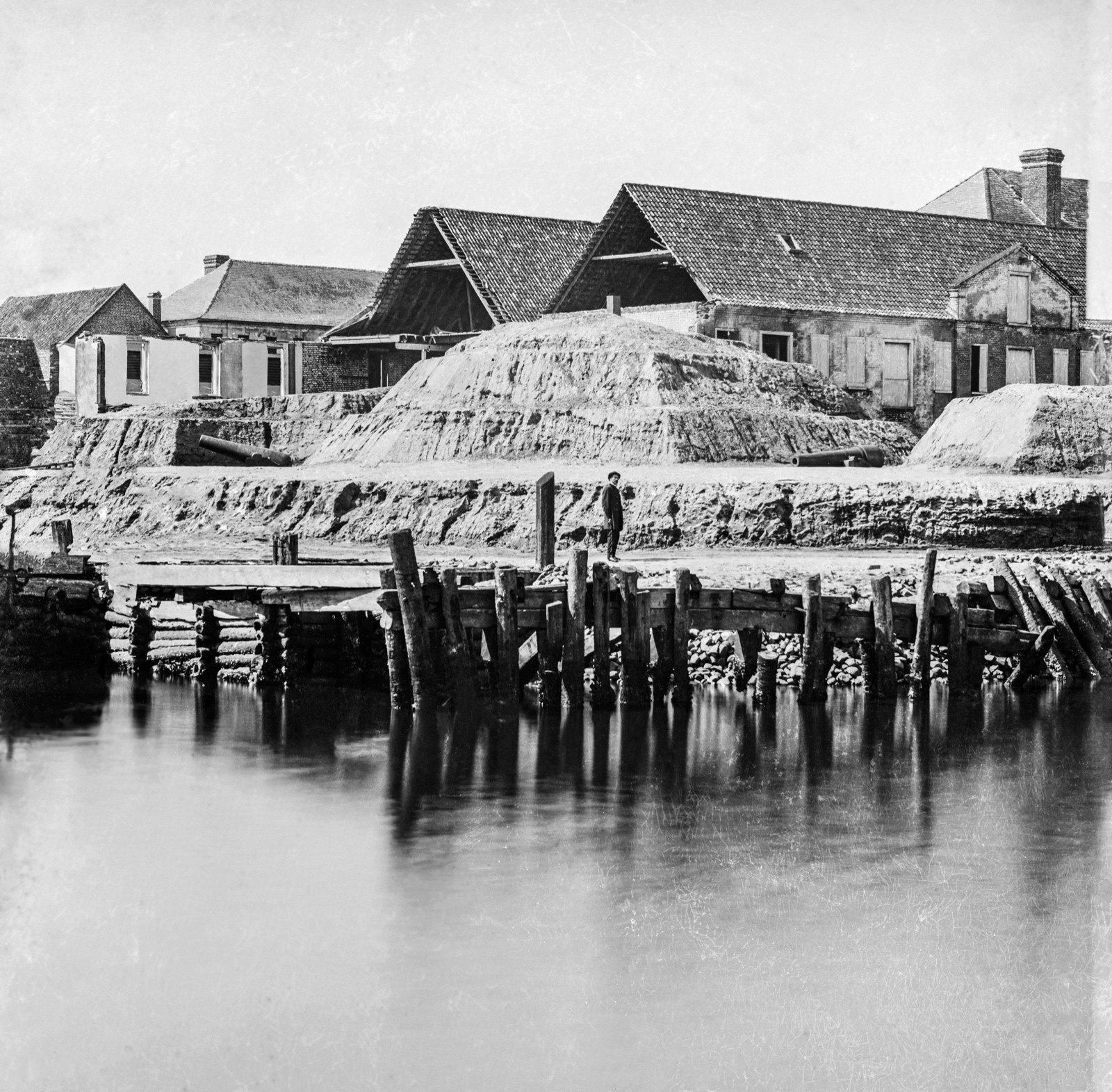
Drag to compareLibrary of Congress
Elias Vanderhorst's wharf ran out into the Cooper River at the foot of Tradd Street, about a quarter mile northeast of the peninsula's tip. The Confederates built an earthen work on the shoreline beside it and put two heavy guns in the emplacement: a 10-inch Columbiad smoothbore and a rifled and banded 42-pounder.
That second piece is worth pausing on. A banded and rifled 42-pounder was an old smoothbore given a second life — the tube bored with rifling grooves to take an elongated projectile, and a wrought-iron reinforcing band shrunk on over the breech to contain the higher chamber pressures that rifling produced. Its bore came out at seven inches. The Confederacy did a great deal of this, because it had far more obsolete smoothbores on hand than it had capacity to found new rifles. The conversions worked, but they were watched carefully; banded guns had a reputation for letting go at the breech.
The position sat well inside the effective range of the Federal Parrott rifles on Morris Island, which is the point of the photograph. Everything visible here — the sand parapet, the timber revetment, the platforms — was built and manned under fire.
In April 1864, twenty-one-year-old Sgt. Augustine Thomas Smythe was on this ground and came close to being killed on it. He wrote home about it in the flat, faintly amused tone that runs through the whole of his wartime correspondence:
Just at the corner of Tradd & the Bay, as I was going to step on one end of a cellar door, a shell fell on the other end, not three feet away from me & burst down in the cellar, covering me with dirt & smoke but leaving me unharmed. Had it burst on level ground it would have killed me. One piece knocked the pipe out of my mouth & so close did it come that I could feel the wind. This is just a little closer than I care to have them come again.
Smythe survived the war, read law, and served in the South Carolina senate. His letters, written from inside the bombarded city, are among the best first-person sources for what the shelling was actually like to live under, and they run through this book at several points.
The caption as printed in the book
Elias Vanderhorst’s Wharf jutted into the Cooper River at the foot of Tradd Street, a quarter mile northeast of the peninsula’s tip. Confederates constructed an earthen fortification on its shoreline that held a 10-inch Columbiad smoothbore and a rifled and banded 42-pounder (7-inch bore diameter). This area was well within the effective range of Union cannon on Morris Island. In April 1864, twenty-one-year-old Sgt. Augustine Smythe had a close call, as he explained in a letter: Just at the corner of Tradd & the Bay, as I was going to step on one end of a cellar door, a shell fell on the other end, not three feet away from me & burst down in the cellar, covering me with dirt & smoke but leaving me unharmed. Had it burst on level ground it would have killed me. One piece knocked the pipe out of my mouth & so close did it come that I could feel the wind. This is just a little closer than I care to have them come again.