Charleston Scenes · Book p. 51
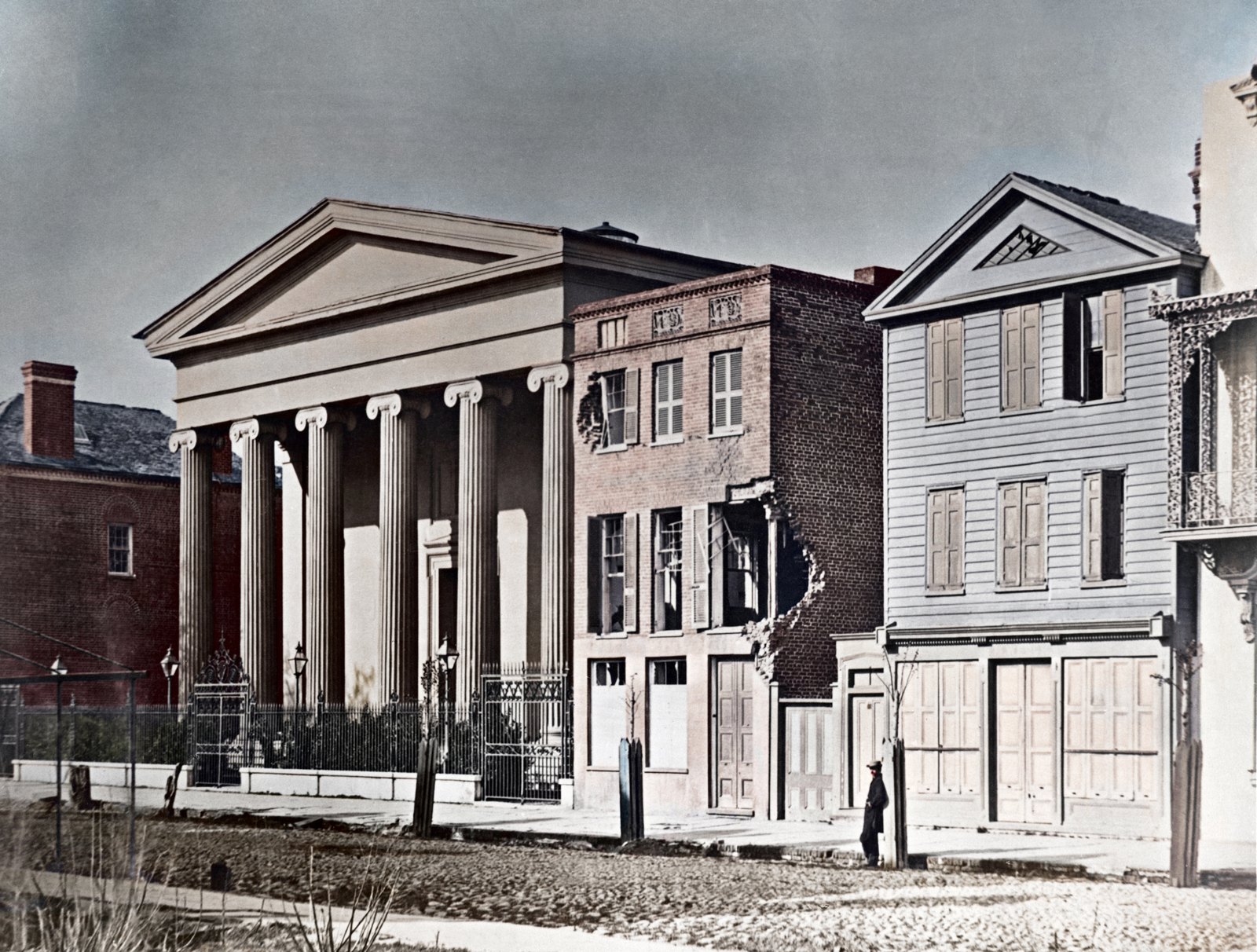
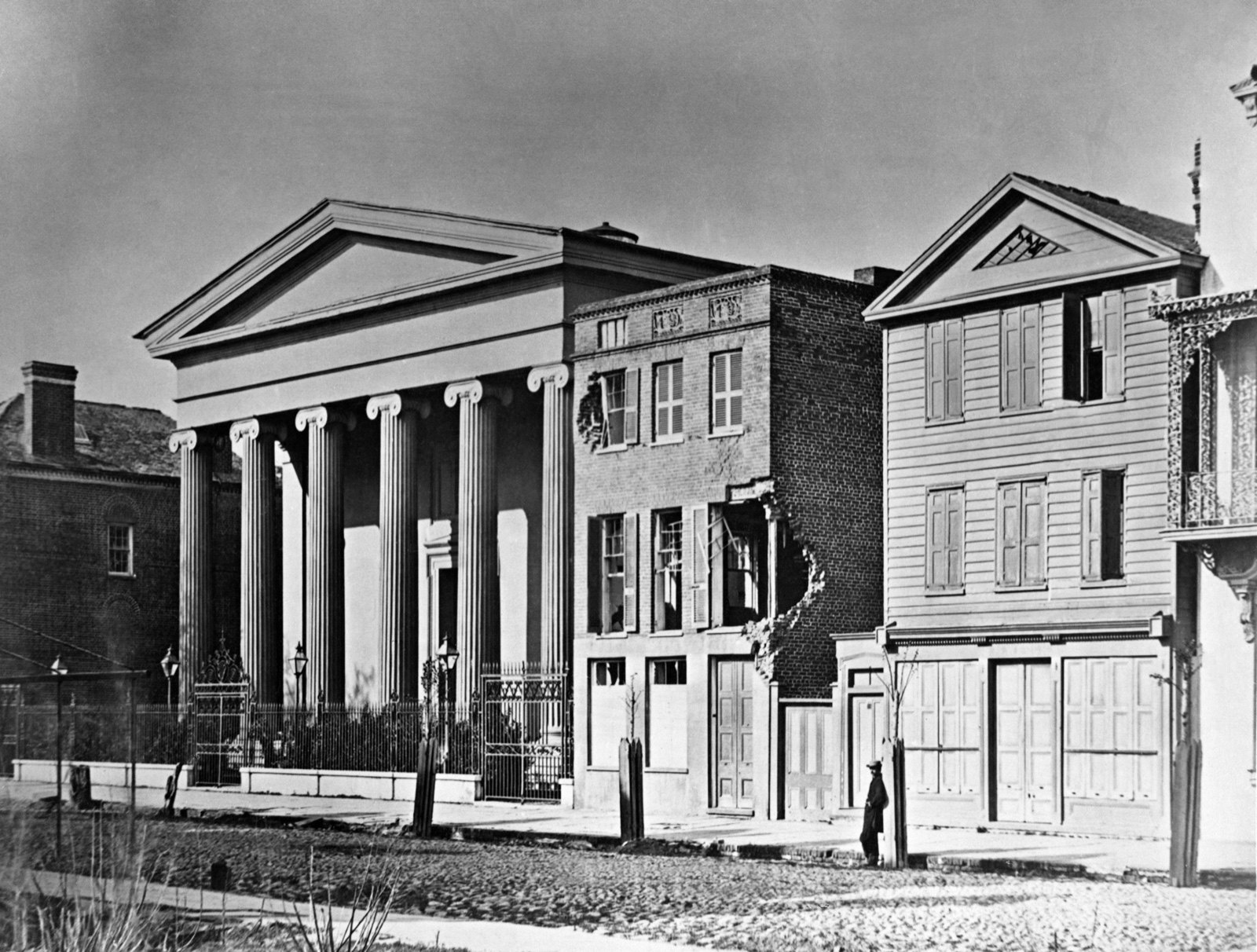
Effect of a Shell Explosion on Meeting Street
Drag to compareLibrary of Congress
The cosmopolitanism of antebellum Charleston is reflected by the fact that around the year 1800 the city had the largest community of Jews in the country. There were so many Catholics that a Hibernian Society had been founded, followed by the construction of Hibernian Hall in 1841. Its Greek Revival façade led to the hall being regarded as among the finest architecture in Charleston. Hibernian Hall stood on the west side of Meeting Street between Queen and Broad— decidedly in the shell district. In March 1864 Augustine Smythe, a Confederate signalman, was stationed in the steeple of St. Michael’s Episcopal Church. From his elevated perch—tallest in the city— Sergeant Smythe could see a lot of the Northern shells’ damage to buildings in the area. On June 9, 1864, he wrote his mother that two projectiles had struck Hibernian Hall, but evidently on its south wall—which he was facing—as no perforations are shown in this view (looking west). Rather, the dramatic shell damage shown in this photograph, taken in late March 1865, occurred in the three-story brick building next to the hall. It served as the bar-room of the Mills House (far right). The projectile, on its northwest course from Morris Island four miles away, entered the building on its third-story corner, plunged through the floor and exploded, knocking out the entire brick corner. On closer view, one can see that all the glass windows of the building have been shattered by the blast. The Mills House saloon was thus out of operation. For this reason, Jack Thomson writes, “arrival of this particular shell probably caused more sadness than anger to the population.”
This is the caption as printed in 100 Significant Civil War Photographs: Charleston in the War. It has not yet been through this site’s research and fact-checking pass.