Race Course and Federals' Graveyard · Book p. 140
Federal Soldiers' Cemetery
The graves behind the grandstand at the Washington Race Course — and the ceremony that may have begun Memorial Day.
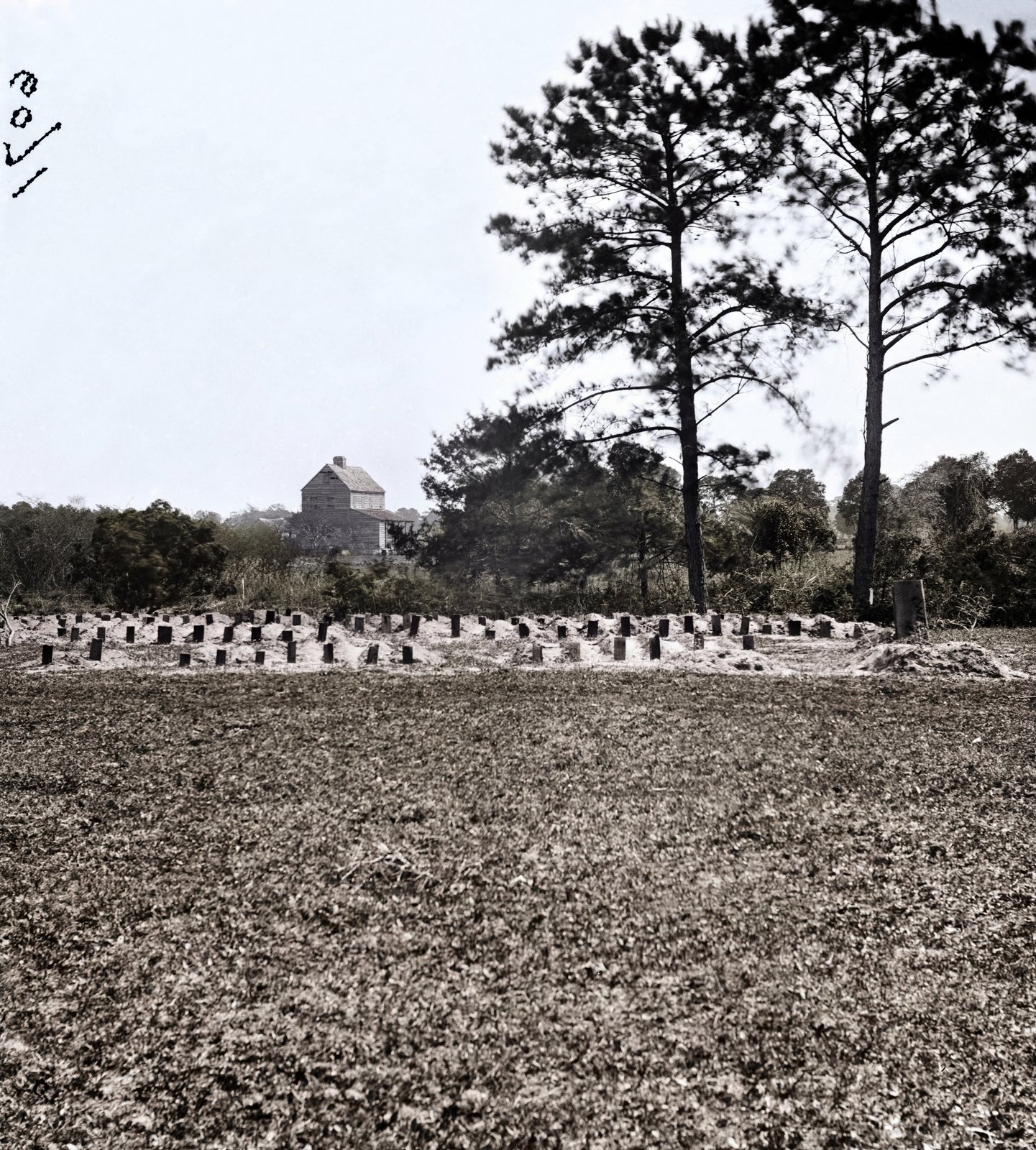
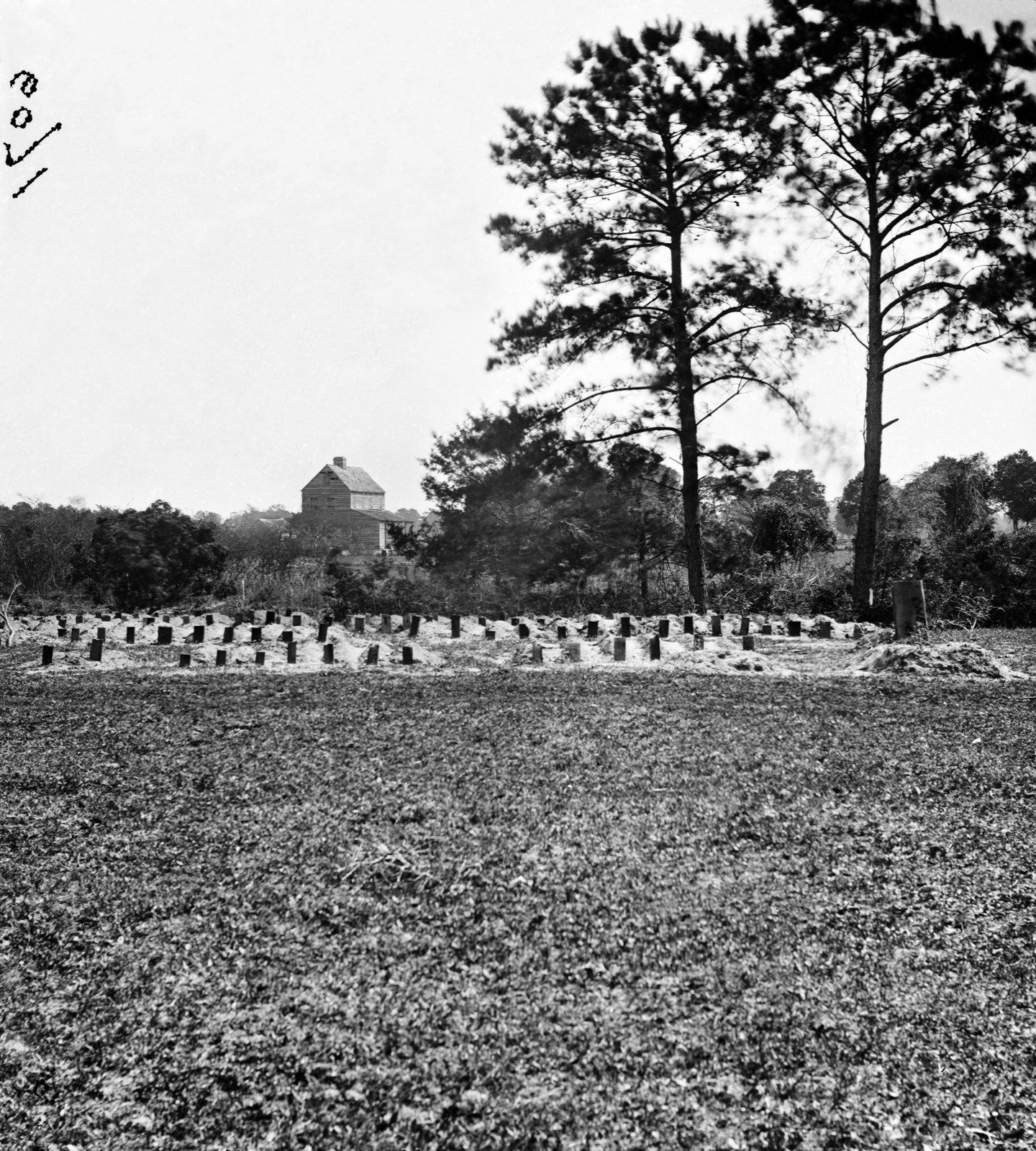
Drag to compareLibrary of Congress
In the last year of the war the Confederates turned the Washington Race Course — the planters' track north of the city, home of Race Week and the Carolina Jockey Club — into an open-air prison for captured Union soldiers. There were no barracks. Men lived in the infield through a lowcountry winter, and they died of what always killed prisoners on both sides: chronic diarrhea and dysentery, scurvy, typhoid, malaria. At least 257 died and were put into a mass grave behind the grandstand.
This photograph shows the burial ground laid out in ordered rows with wooden headboards. That order was not the work of the army. In the days after Charleston fell, freedpeople of the city went out to the racecourse, disinterred the men from the mass grave, and reburied them properly in individual plots. They fenced the ground with a ten-foot whitewashed enclosure and built an archway over the entrance lettered, in black, Martyrs of the Race Course.
On May 1, 1865, something close to ten thousand people came out to dedicate it. The procession was led by roughly three thousand black schoolchildren carrying armfuls of roses and singing “John Brown's Body,” followed by women's aid societies, black ministers, and Union regiments including the 54th Massachusetts and the 35th United States Colored Troops. There were sermons, a picnic, and drill on the infield where the prison pen had been. Historian David W. Blight, who reconstructed the event from Federal records and the Northern press, has argued that it is the earliest known Decoration Day — the ceremony from which Memorial Day descends.
A Northern visitor to the graves that April recorded the limit of what could be done for the men buried there:
Over two-hundred head-boards can be counted in the yard; but these only avail to keep up a decent respect for the name and memory of the departed. Identification is impossible.
The dead did not stay. Around 1868 the remains were disinterred again and moved to the national cemetery at Beaufort, South Carolina.
The racecourse is now Hampton Park. Nothing of the prison or the burial ground survives on the ground, which makes this photograph one of the very few images of a site central to the history of American commemoration.
The caption as printed in the book
The five-acre race track area became the burial ground for Union prisoners who died of the ailments that took so many imprisoned Federal and Confederate soldiers’ lives: diarrhea, dysentery, scurvy, typhoid fever and malaria. Here are shown some of the cemetery’s 257 graves, photographed soon after the war. One sees headboards at the graves, but in April 1865 a Northerner visiting the cemetery wrote, “over two-hundred head-boards can be counted in the yard; but these only avail to keep up a decent respect for the name and memory of the departed. Identification is impossible.” Around 1868 these remains were reburied at Beaufort National Cemetery.