The Burnt District · Book p. 116
The Fire that Leaped across the Street
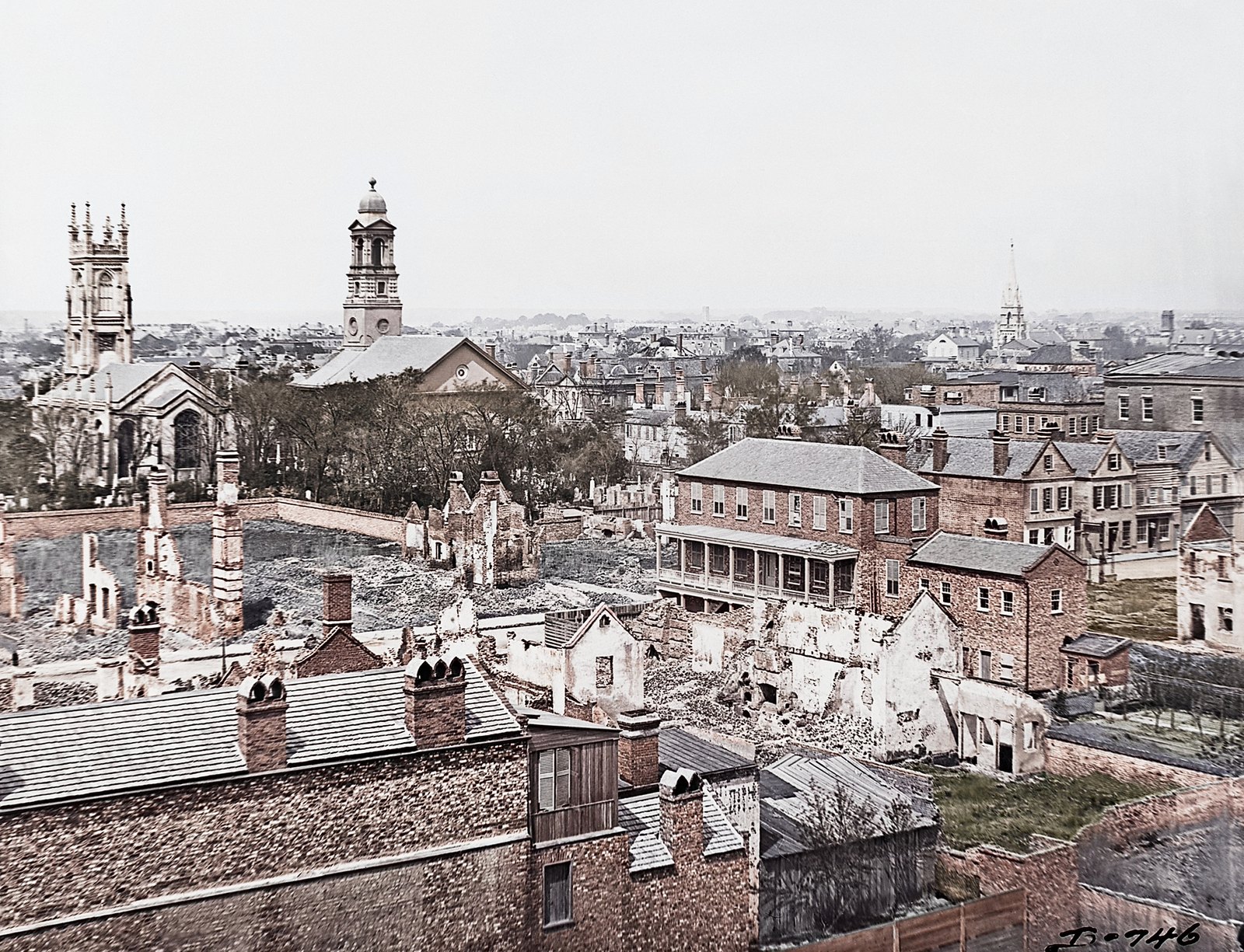
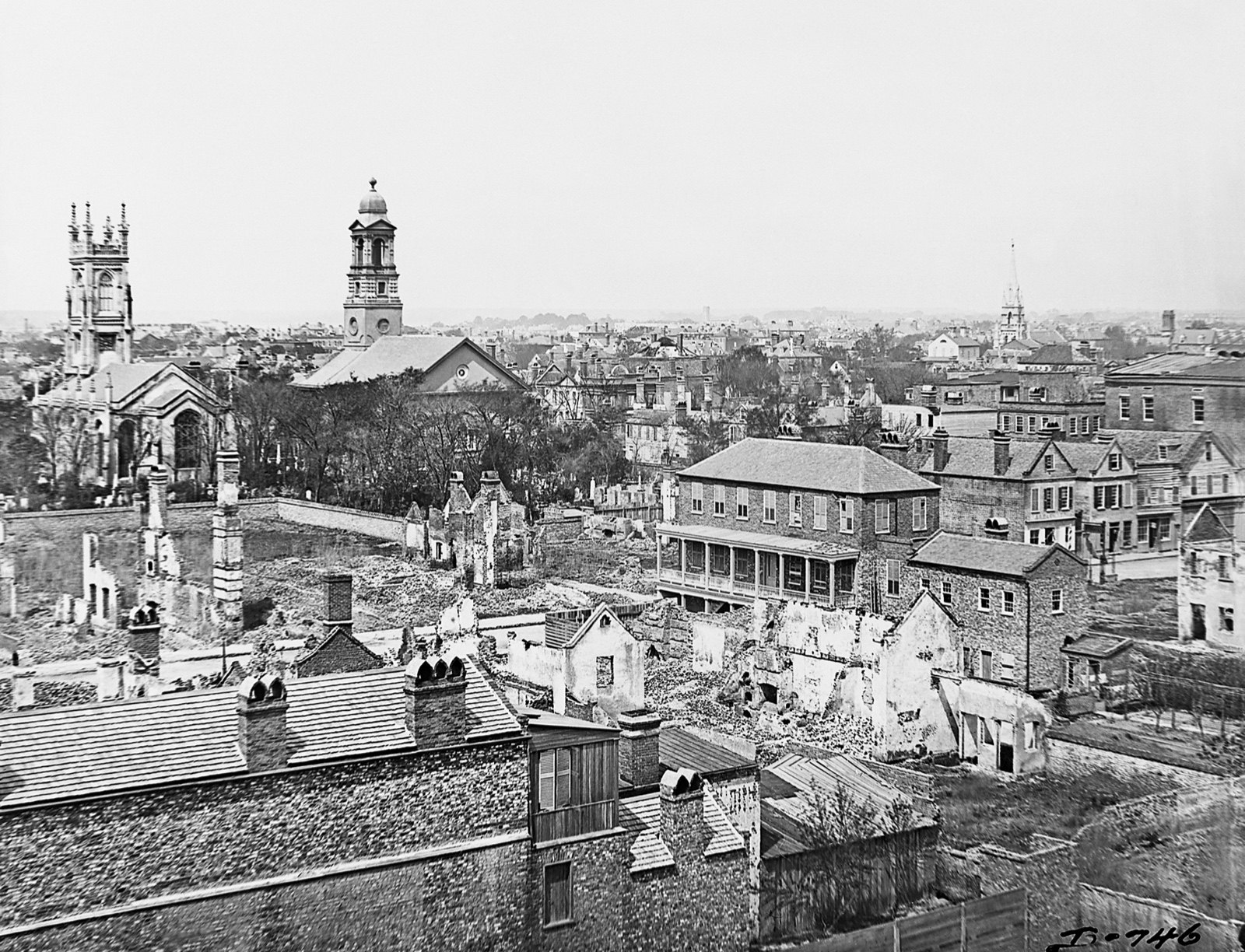
Looking down on the burnt district from the roof of the Mills House — and on the three spires that give the city its nickname.
Drag to compareNational Archives
The photographer carried his camera and tripod to the roof of the five-storey Mills House and pointed it north across the intersection of Queen and King streets. This is the middle of the burnt district, and it is the clearest surviving view of what the Great Fire actually did.
What it did was not uniform. The fire broke out on the evening of 11 December 1861 at the foot of Hasell Street near East Bay — the Mercury put it at Russell & Co.'s sash and blind factory, though others thought it was already burning in Cameron & Co.'s machine shops across the street. Driven by a hard northeast wind, it cut a diagonal swath southwest across the whole peninsula and did not stop until it reached the Ashley River below Tradd Street. It burned some 540 acres and more than a thousand buildings in a single night. But a fire driven that hard does not advance as a line. It jumps. On the right of this view, at 163 and 165 King Street, two stores with brick peak roofs are still standing — one with a barber's pole in front of it — while the buildings around them are gone. Wind, roof material, and whether anyone was on hand with water decided which was which.
The exposure was made in late March 1865, more than three years after the fire, and the district is still in ruins. Carpenters, bricklayers and masons were in the army, and the Federal shelling that began in August 1863 ended what rebuilding had been attempted. Charleston did not fail to rebuild out of despair. It failed to rebuild because there was nobody left to do it and nowhere safe to stand while it was done.
Three spires stand up out of the wreckage, which is why Charlestonians call theirs the Holy City. On the left is the Unitarian Church, given its Gothic tower in an 1854 remodelling. Beside it is St. John's Lutheran, dedicated on 24 June 1764 — St. John's Day, which is how it got the name. In the right distance is the steeple of Grace Episcopal on Wentworth Street, founded in 1846.
All three still stand.
The caption as printed in the book
From the roof of the five-story Mills House the photographer set his camera tripod and took this picture looking north across the intersection of Queen and King streets. This area is in the middle of the Burnt District. More than three years after the fire (this image was made in late March 1865), one sees that many burned buildings have not been rebuilt; carpenters, bricklayers and other craftsmen were in the army, and the shelling begun in August 1863 stopped all repair work. Still, one sees that the Great Fire spread in leaps and bounds, destroying some buildings but sparing others. Example: on the right, at 163 and 165 King, are two stores with brick peak-roofs (the former has a barber pole in front). The spires of three churches remind us that Charlestonians call theirs “the holy city.” The Unitarian Church on the left was renovated in 1854 with construction of its Gothic tower. Next to it is St. John’s Lutheran, dedicated June 24, 1764—St. John’s Day. In the distance, right background is the steeple of Grace Episcopal at 98 Wentworth Street. It was founded in 1846.