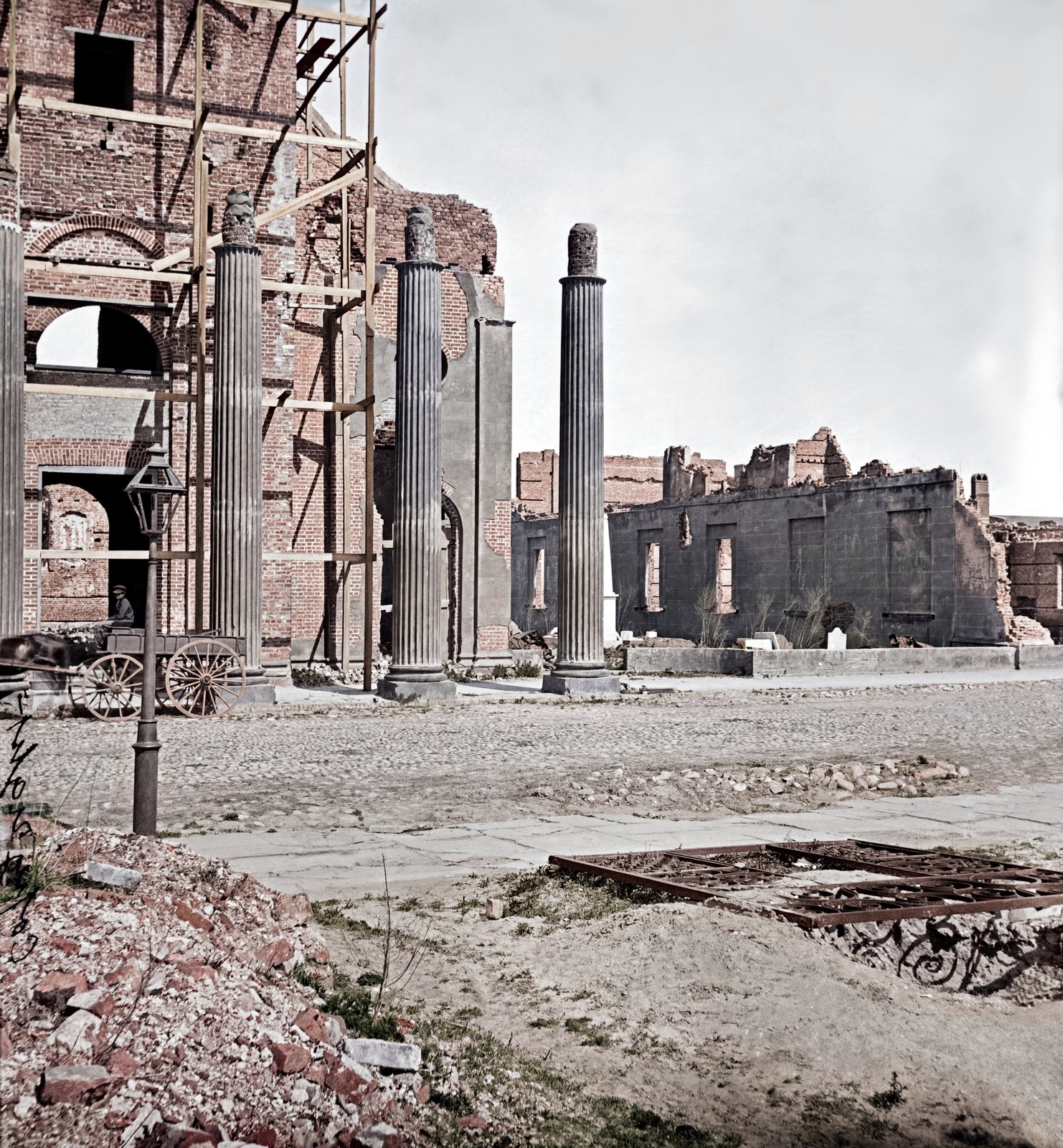
The Burnt District · Book p. 109
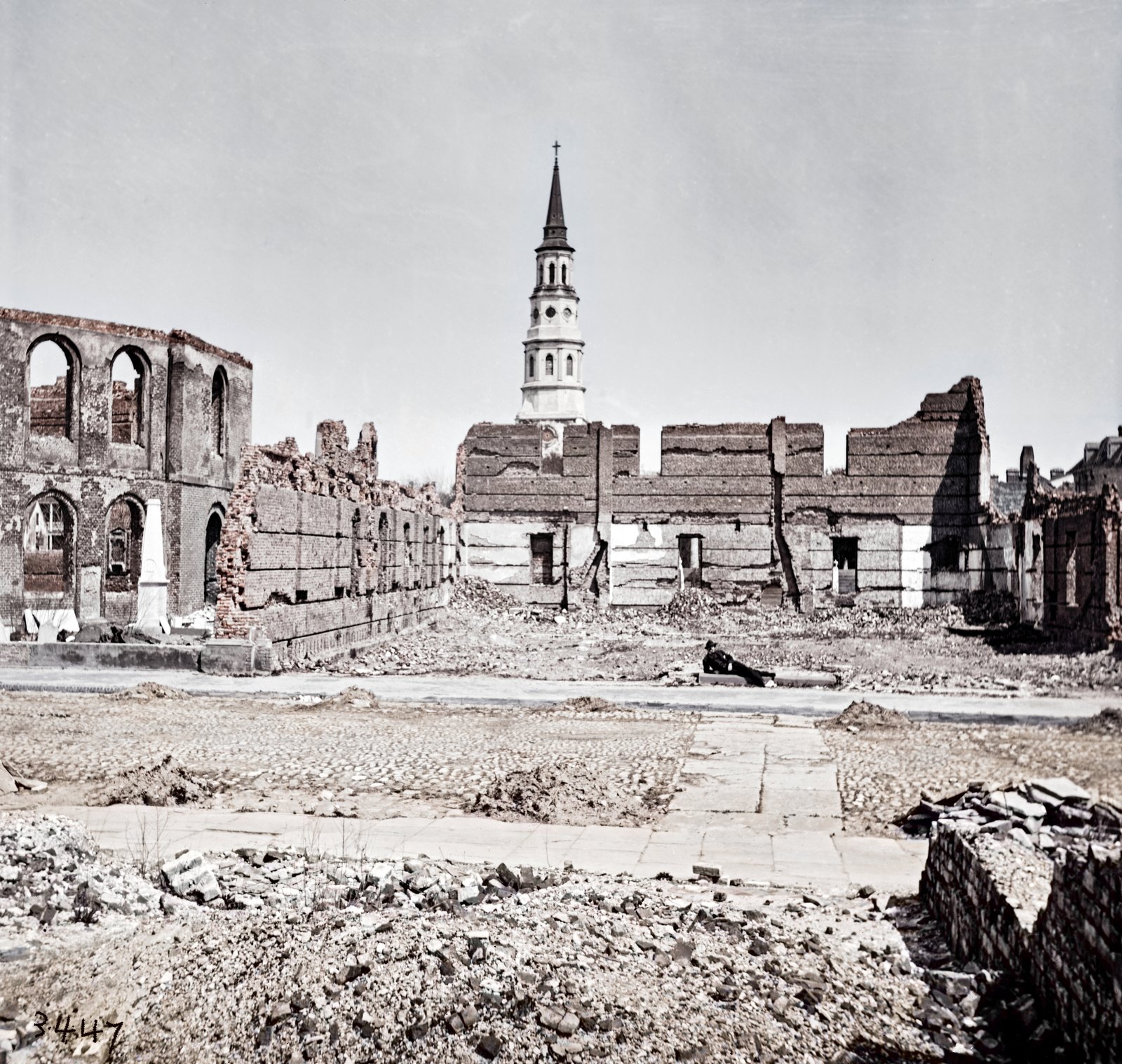
All That Was Left of Secession Hall
Barnard's assistant sits in the ruin of the hall where South Carolina left the Union.
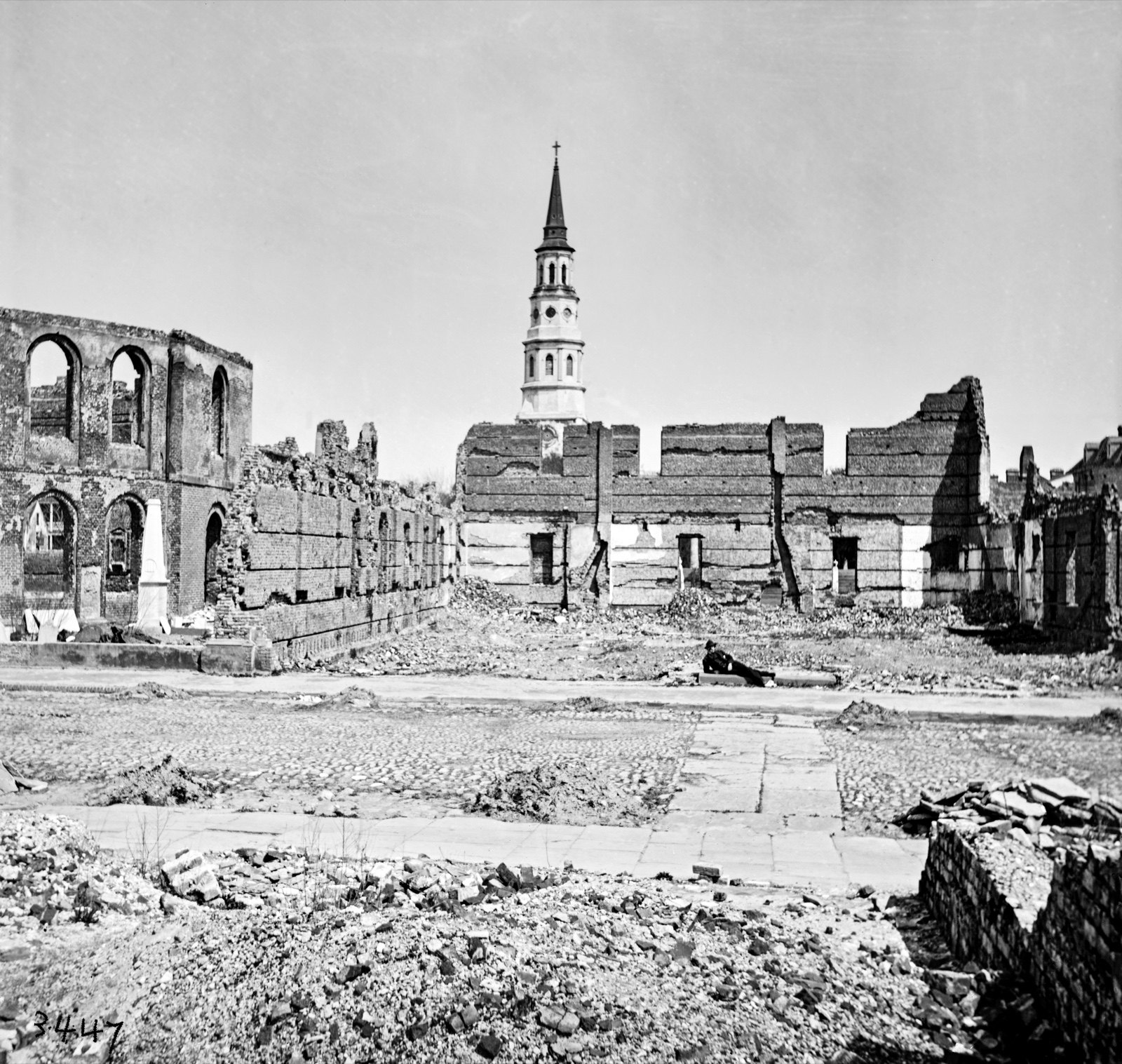
Drag to compareLibrary of Congress
George Barnard put one of his assistants in the foreground here, as he did in a good many of his Charleston views — a figure for scale, and a way of holding the eye where he wanted it. The man is sitting in what had been Institute Hall, called Secession Hall after December 1860. St. Philip's steeple stands in the background. The ruins to the left are the Circular Congregational Church.
The fire broke out on the evening of 11 December 1861 at the foot of Hasell Street near East Bay — the Mercury put it at Russell & Co.'s sash and blind factory, though others thought it was already burning in Cameron & Co.'s machine shops across the street. Driven by a hard northeast wind, it cut a diagonal swath southwest across the whole peninsula and did not stop until it reached the Ashley River below Tradd Street. It burned some 540 acres and more than a thousand buildings in a single night.
Emma Holmes, a Charlestonian five days short of her twenty-third birthday, set down what she had seen on 16 December:
The terror! The misery, & desolation which has swept like a hurricane over our once fair city will never be forgotten as long as it stands…. It swept all the upper part of Hasell & many small streets near, down East Bay…. The fire leapt across to the south side of Market Street which was swept away in a few moments…. destroying the… Circular Church, and, more regretted than all, the Institute Hall, one of the largest in the South…. That loss can never be repaired.Emma Holmes, diary, 16 December 1861
What started it was never established. Union rockets, saboteurs and a cooking fire among the refugees camped along the waterfront have all been offered since, and the last of those is still repeated as fact in Charleston. The record does not support any of them. The city was crowded with people displaced from the sea islands, the fire companies were thinned by enlistment, and the wind did the rest.
She was right that it could not be repaired. The Circular Church congregation rebuilt on its own site in 1892. Institute Hall never rose again, and the walls in this photograph were cleared rather than restored. What Barnard's assistant is sitting in is the last of it.
The caption as printed in the book
In this view, as in others, George Barnard has one of his assistants resting in front of what was once Institute Hall, called “Secession Hall” after December 1860. St. Philip’s steeple can be seen in the background. The Great Fire of Dec. 11-12, 1861, completely gutted the hall. To the left are ruins of the Circular Church. On December 16—the day before her 23rd birthday—Charlestonian Emma Holmes recorded in her diary impressions of the huge conflagration: The terror! The misery, & desolation which has swept like a hurricane over our once fair city will never be forgotten as long as it stands…. It swept all the upper part of Hasell & many small streets near, down East Bay…. The fire leapt across to the south side of Market Street which was swept away in a few moments….destroying the…Circular Church, and, more regretted than all, the Institute Hall, one of the largest in the South…. That loss can never be repaired.
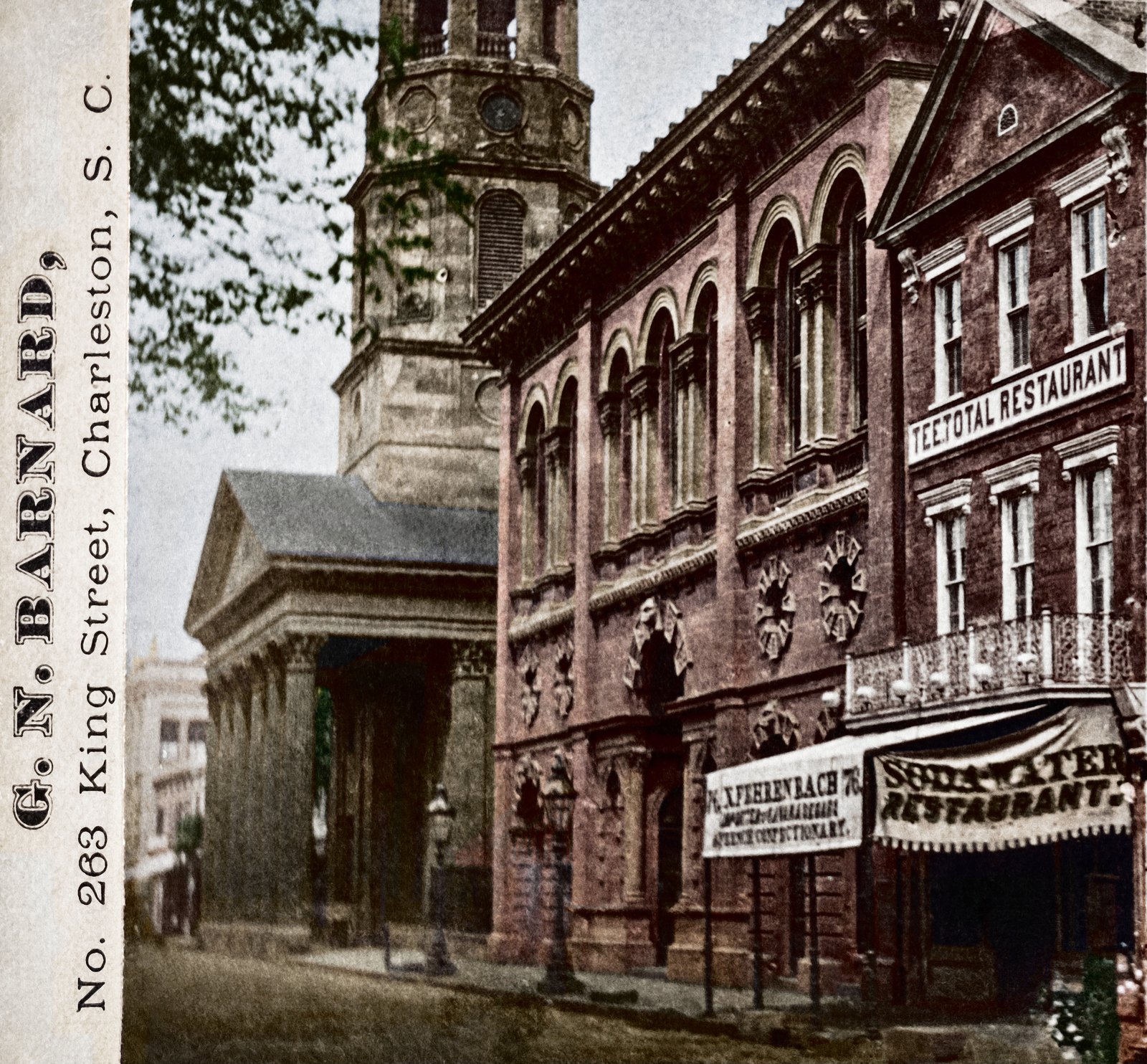
Also at Institute Hall