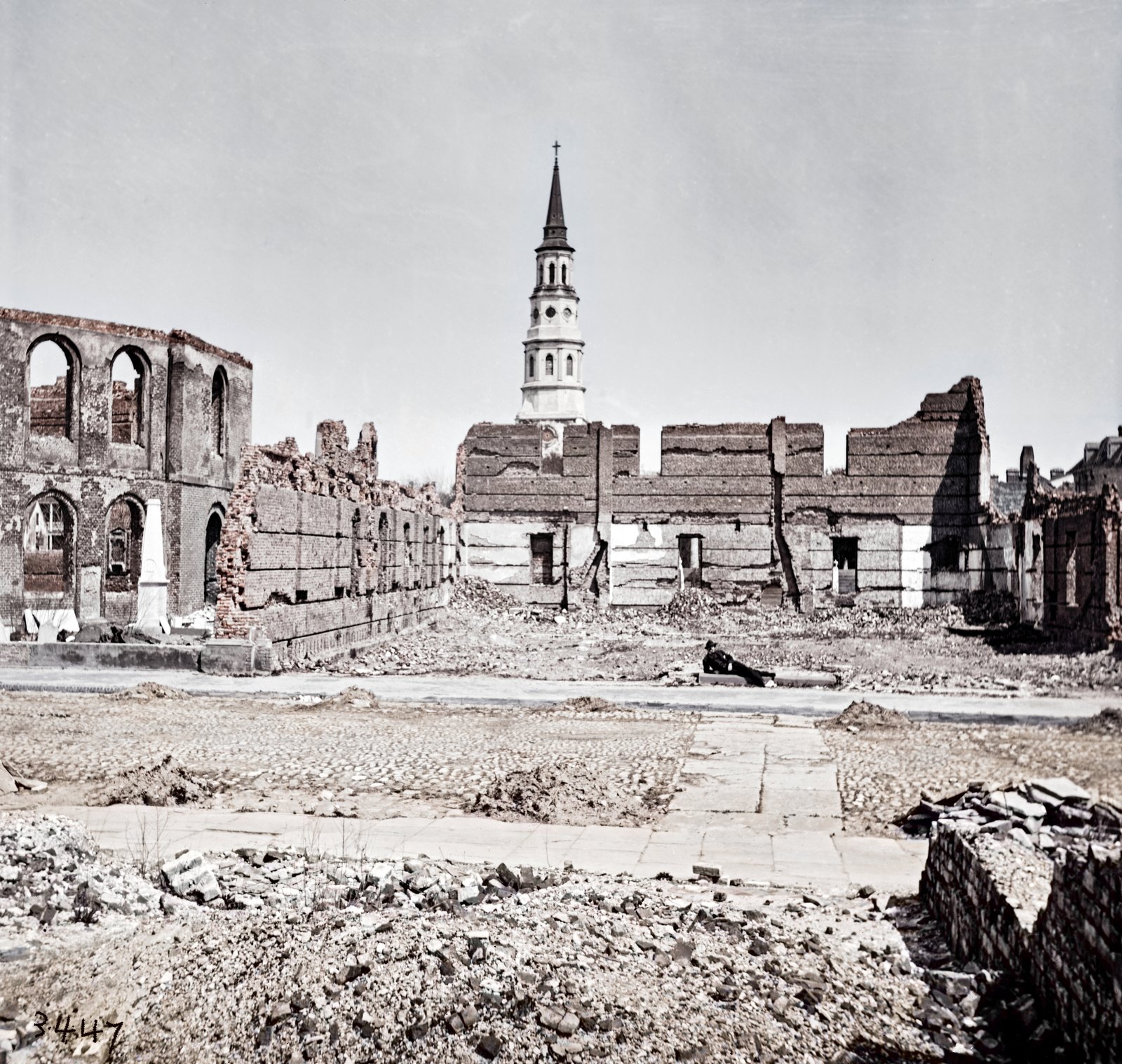
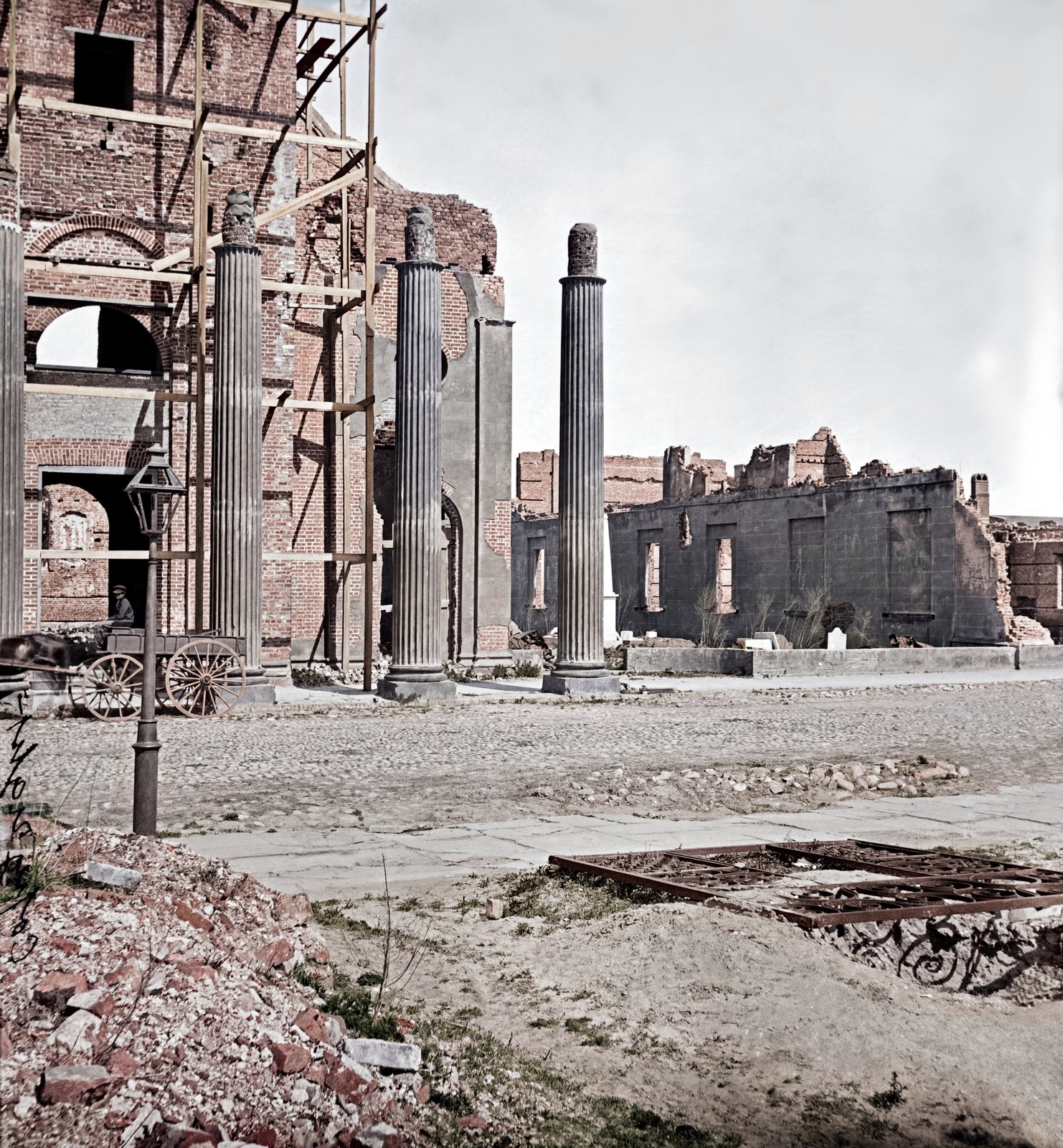
The Burnt District · Book p. 108
Secession Hall Before the Fire
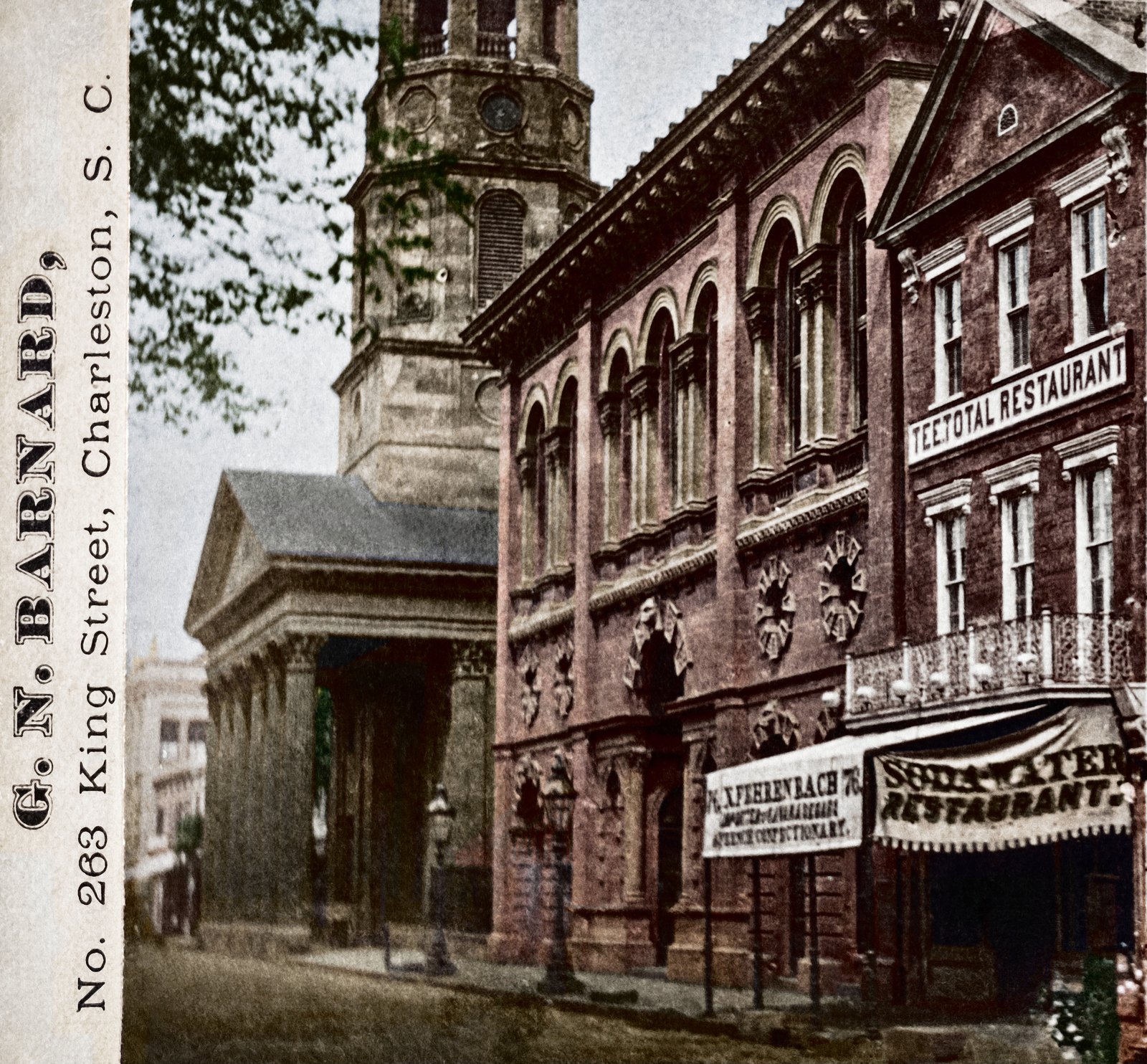
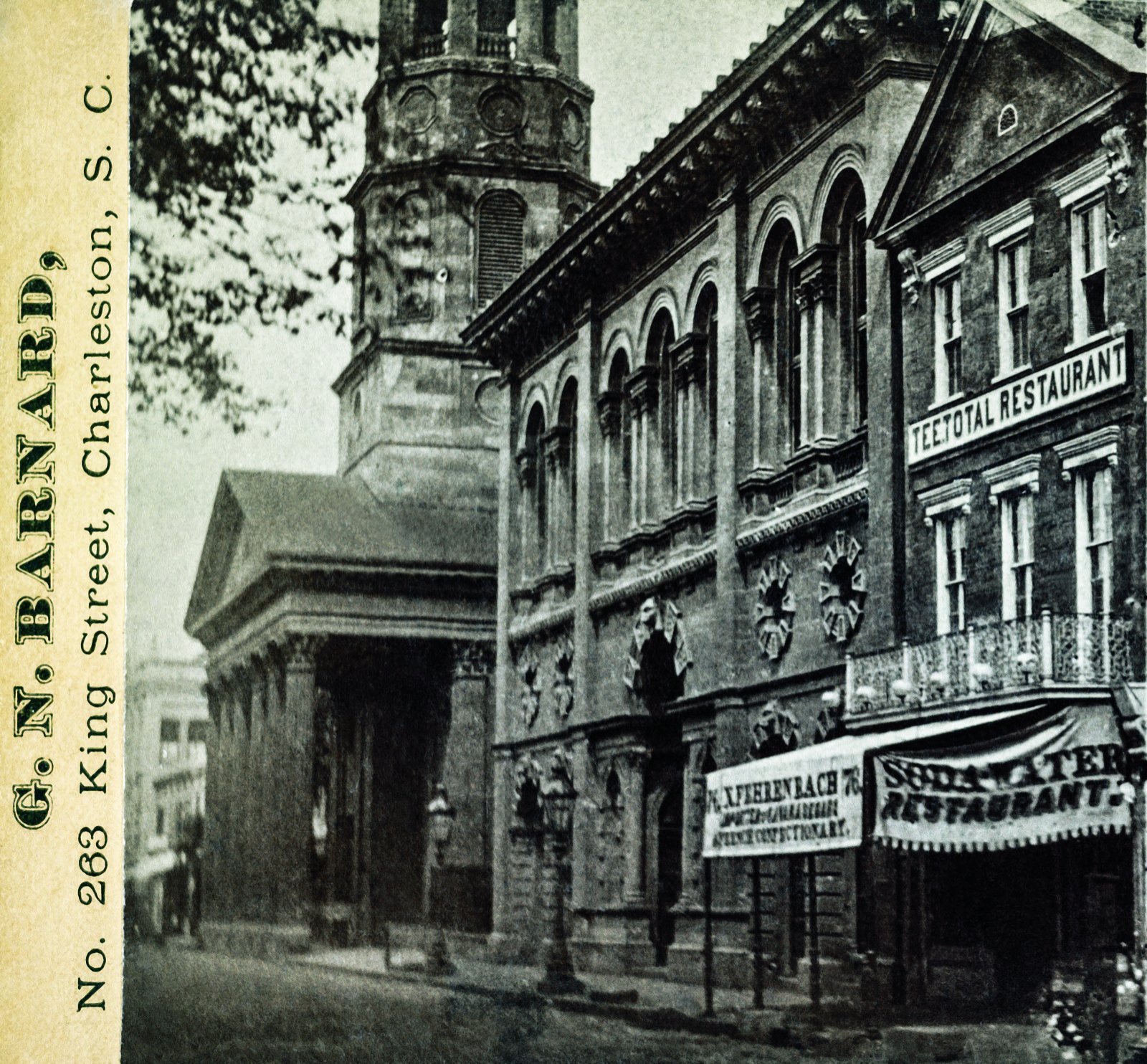
Institute Hall on Meeting Street, photographed while it still stood — where the Ordinance of Secession was signed, and where it burned a year later.
Drag to compareLibrary of Congress
South Carolina's secession convention was a restless body. It opened in Columbia, and when word of a smallpox outbreak reached the delegates they took the train to Charleston on 17 December 1860. They met first at Institute Hall on Meeting Street — the building at the center of this photograph, wedged between the Circular Congregational Church and Nicholas Fehrenbach's Teetotal Restaurant, a signboard that leaves nothing in doubt about the house policy.
Then they moved three blocks to St. Andrew's Society Hall on Broad Street, and it was there, at about one o'clock on 20 December, that the convention voted unanimously to sever the state's ties to the Union. The vote was the easy part. The signing was going to draw a crowd, and no hall on Broad Street could hold it, so that evening they came back to Institute Hall.
The building had been put up in 1854 to designs by the Charleston firm of Jones & Lee, an Italianate pile built for the South Carolina Institute — an organization devoted, without any sense of irony that survives, to "art, ingenuity, mechanical skill, and industry." Its Grand Hall was the largest public room in the city. Thomas C. Perrin signed first. Edmund Ruffin, sixty-six years old and in the audience as he was in the audience for everything that winter, wrote down what happened when the last of the hundred and seventy delegates had put his name to the page:
Every man waved or threw up his hat; every lady waved her handkerchief.Edmund Ruffin, diary
The building was Secession Hall from that night on. The name lasted a little under twelve months. The fire broke out on the evening of 11 December 1861 at the foot of Hasell Street near East Bay — the Mercury put it at Russell & Co.'s sash and blind factory, though others thought it was already burning in Cameron & Co.'s machine shops across the street. Driven by a hard northeast wind, it cut a diagonal swath southwest across the whole peninsula and did not stop until it reached the Ashley River below Tradd Street. It burned some 540 acres and more than a thousand buildings in a single night.
Nothing of it survives. The site at 134 Meeting Street carries a marker and nothing else. This photograph, made before December 1861, is one of the few images of the room where the Union was formally dissolved.
The caption as printed in the book
The South Carolina secession convention proved to be mighty migratory. “The Convention of the People of South Carolina” had convened in the state capital of Columbia when word of a smallpox outbreak sent the delegates scurrying by train to Charleston on Dec. 17, 1860. First, they met at Institute Hall, on Meeting Street, shown here sandwiched between the Circular Congregational Church and Nicholas Fehrenbach’s Teetotal Restaurant (talk about telegraphing no alcohol). Then they moved to Saint Andrew’s Society Hall on Broad Street, three blocks away. It was there, around 1 p.m. on December 20, that the convention voted unanimously to sever South Carolina’s ties to the federal Union. But they were not yet done. The signing of the Ordinance of Secession was sure to draw a huge crowd. So they moved back that evening to the 2,500-seat Institute Hall, where Thomas C. Perrin became the first delegate to sign his name. Edmund Ruffin, the sixty-six-year-old Southern Rights man, was in the audience (of course). When the last of the 170 delegates had added his signature, “every man waved or threw up his hat,” Ruffin recorded in his diary; “every lady waved her handkerchief.” The South Carolina Institute Hall soon became known as Secession Hall. But the appellation proved short-lived. Within a year the building would be consumed in the Great Fire of December 1861.
Also at Institute Hall