Charleston Scenes · Book p. 68
“Rice is Gold”
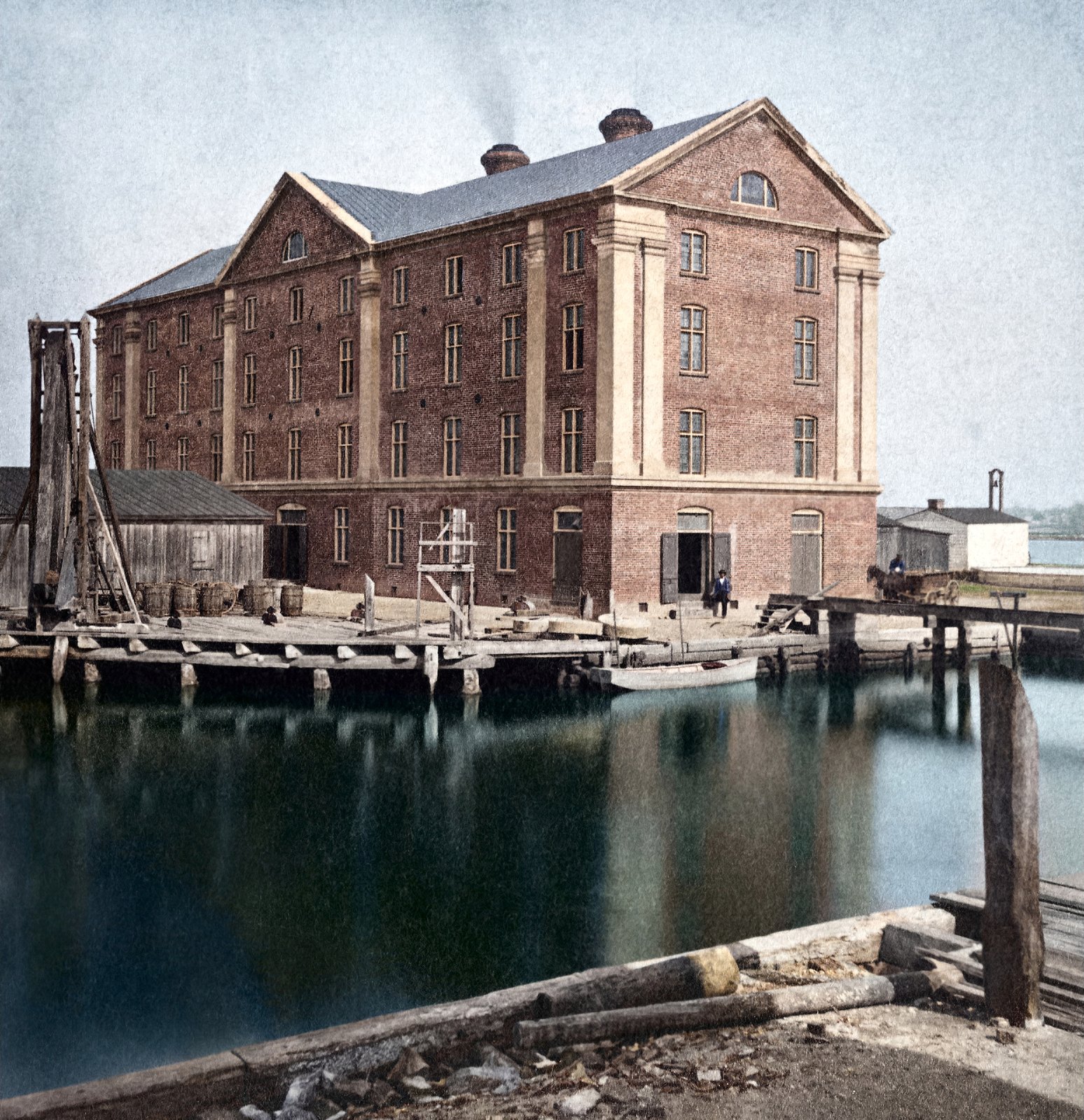
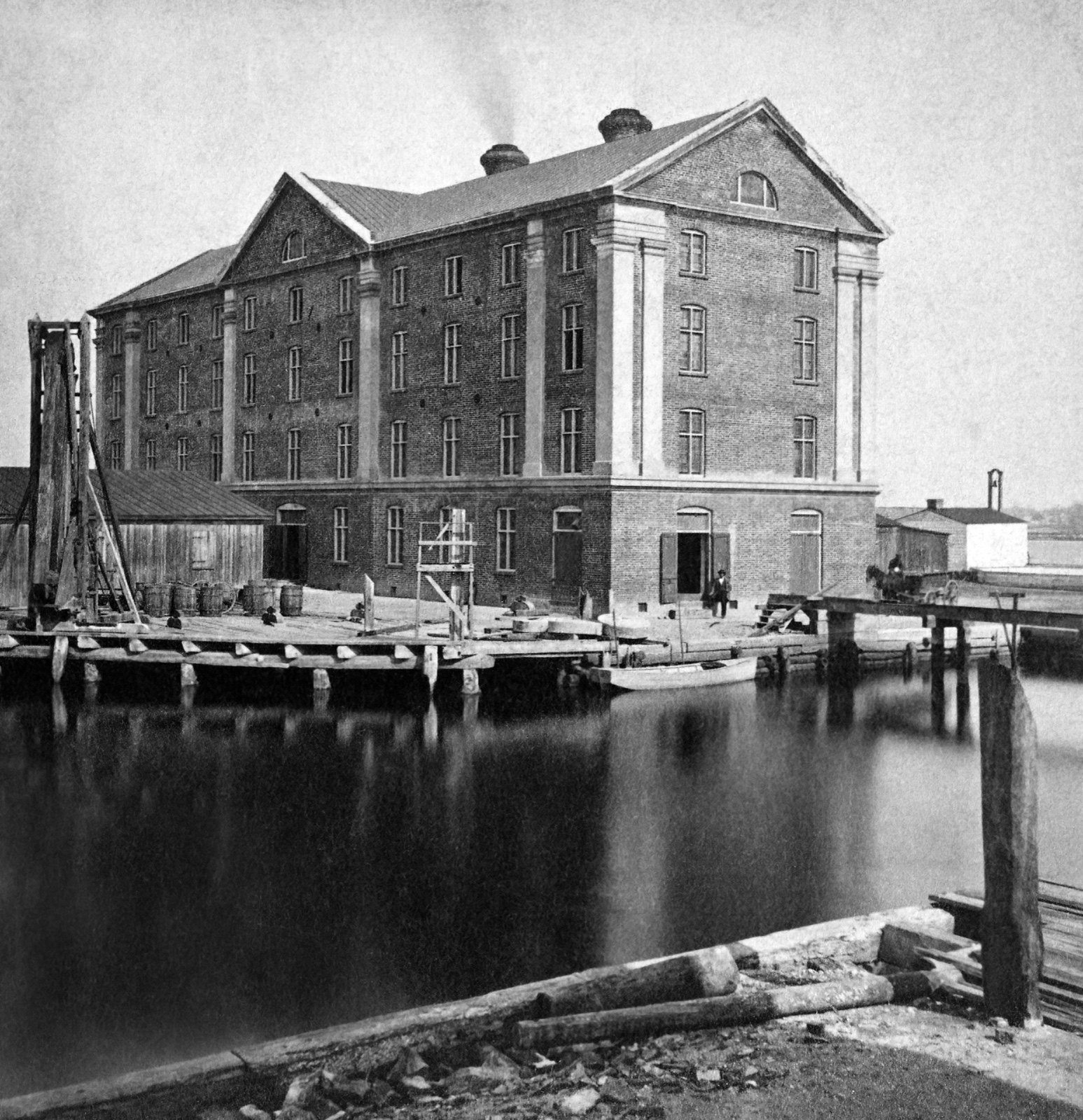
The West Point Mill on the Ashley — the largest rice mill in the city, and the only one still standing.
Drag to compareOrlando M. Poe Papers, Special Collections, USMA Library
Charleston's wealth rested on two crops and the trade that moved them. Long-staple cotton grew on the sea islands and short-staple inland, and in 1816 planters saw thirty-five cents a pound — a record that stood for the rest of the antebellum period. But cotton was the newcomer. Rice had built the lowcountry, and the men who grew it liked to say that cotton is king, and rice is gold.
What turned rice from a crop into an industry was milling. Threshed rice has to be pounded to strip the husk and then polished, and doing that by hand set a hard ceiling on how much a plantation could bring to market. Jonathan Lucas had introduced water-powered pounding mills in the lowcountry in the 1780s; steam removed the last limit. By the 1850s Charleston's steam mills could take in rough rice from up the rivers and turn out a clean, export-grade product on a scale nothing else in North America matched.
This is the West Point Mill, on the Ashley River at the western edge of the peninsula, the largest of the several rice mills in the city. Its history is more complicated than it looks. A West Point mill built about 1839–40 by a grandson of Jonathan Lucas — reportedly the largest steam rice mill in South Carolina — burned in 1859. The building in this photograph is its replacement, put up in 1861, which makes it one of the very few substantial structures raised in Charleston after secession. Two steam engines were installed; smoke is rising from one of them as the picture was made.
The mill ran on enslaved labor. It continued grinding through the war, hampered by the blockade but capable of full operation as late as 1863, turning out rice for soldiers and civilians until December 1864. It stood far enough up the Ashley to be out of effective range of the Federal batteries on Morris Island, and it came through the bombardment without shell damage — a rarity worth noting in a book largely made of shell holes. Under Federal occupation in 1865 it was put to use as a food distribution center.
Carolina's rice economy did not survive the loss of forced labor and the storms of the 1890s by more than a half-century. The West Point Mill outlasted the industry it served. It is the only completely intact rice mill left in Charleston, was restored in the mid-1990s, entered the National Register, and stands today at the City Marina on Lockwood Drive as offices and an event space.
The caption as printed in the book
In the 18th and 19th centuries, Charlestonians’ wealth was built on agriculture and trade. Planters of both long-staple cotton, grown along the coast, and short-staple, grown father inland, enjoyed in 1816 a price of 35 cents a pound, a record for the antebellum era. For rice planters, a major boon was the adoption of steam-powered rice mills to pound the threshed rice, remove the husks and polish the grains. Rice planters were fond of saying, “cotton is king, and rice is gold.” This is the West Point Rice Mill. Located on the Ashley River along Charleston’s western shoreline, West Point was the largest of several rice mills in the city. At the time of the Civil War, two steam engines had been installed; smoke is to be seen rising from one of them. In 1860 owners of the West Point Mill owned 160 slaves. During the war it continued to grind rice for soldiers and civilians until December 1864; it was sufficiently beyond effective range of Northerners’ artillery so as to avoid shell damage. The building still stands today. Carolina’s rice economy faded a half-century after the war; the West Point Mill is now the site of offices and a tony restaurant.